
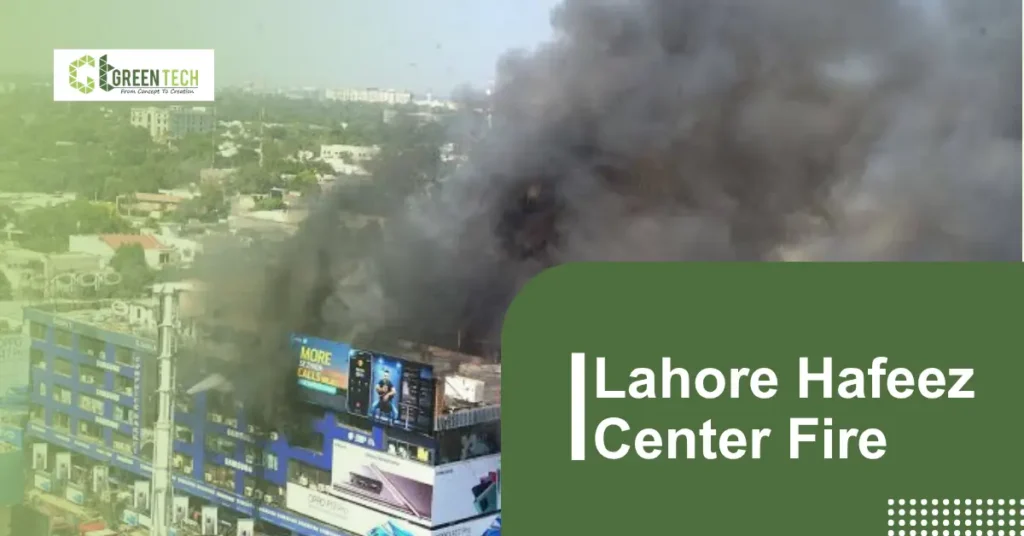
Hafeez Center in Gulberg, Lahore — one of Pakistan’s largest electronics, mobile, and IT markets — has caught fire more than once over the past few years. It isn’t a single isolated incident; it’s a recurring case study in what happens when a dense, multi-storey commercial plaza operates without integrated fire protection.
Each time, the same failures surface: no early detection, non-functional hydrants, and no suppression system to slow the spread.
That pattern is exactly why Hafeez Center keeps coming up in fire safety discussions in Pakistan — not as old news, but as a live example of risks that still exist in shopping plazas and business hubs across the country.
Table of Content
ToggleIncident Overview
Detail | Information |
Location | Main Boulevard, Gulberg, Lahore |
Type of Building | Multi-storey commercial plaza (electronics, mobile, IT market) |
Most severe incident | October 2020 — fire spread from the 2nd to the 4th floor |
Recent recurrence | 2025 — fire broke out in the basement, spreading smoke through the building |
Shops affected | Reportedly 400+ shops, godowns, and repair units in the 2020 fire |
Losses | Hundreds of millions of rupees |
Reported cause(s) | Short circuit / electrical fault cited across incidents |
Rescue 1122’s own leadership pointed to the core issue directly after the 2020 fire: smoke detection alarms and water hydrants installed in the building were reportedly non-functional at the time. That single detail explains most of what follows.
Why the Fire Caused Severe Damage
Across the reported incidents at Hafeez Center, the same gaps show up:
Issue | Explanation |
No early detection | Fires were not caught before they had already spread across floors |
Non-functional alarms | Detection hardware was reportedly present but not maintained or operational |
No suppression system | Nothing to slow or extinguish the fire automatically once it started |
Dysfunctional hydrants | On-site firefighting water supply was not usable when needed |
Poor evacuation planning | No clear emergency exit routes for a building housing hundreds of shops |
A working fire alarm system closes the detection gap, while a properly maintained fire suppression system is what actually stops a small fire from becoming a multi-floor loss. Neither works in isolation — and neither works at all if it isn’t inspected regularly, which is where most buildings like Hafeez Center fall short.
Essential Fire Safety Systems for Commercial Buildings
Preventing another Hafeez Center-style loss means treating fire protection as a full system, not a single device.
System | Purpose |
Fire Alarm System | Early detection and occupant alerts |
Fire Extinguishers | Immediate, manual fire control at the source |
Sprinkler System | Automatic suppression without human intervention |
Fire Hydrant System | Water supply for large-scale firefighting |
Fire Pump | Maintains hydrant and sprinkler water pressure |
Passive Fire Protection | Fire-rated walls, doors, and seals that contain spread between floors |
CCTV & Monitoring | Verifies alarms and supports faster emergency response |
For a building the size and density of Hafeez Center, this typically means an addressable fire alarm system that pinpoints the exact floor and zone of a fire, paired with a fire hydrant system and fire pump sized for a multi-storey plaza.
A fire sprinkler system covers the automatic-suppression gap that let the 2020 fire spread floor to floor, and basic fire extinguishers remain the first line of defense for shop-level incidents before they escalate.
For plazas with server rooms, generator bays, or electrical switchgear — common in an electronics market — a special hazard fire suppression system or fire deluge system is worth evaluating alongside the standard setup, since ordinary sprinklers aren’t always suited to those risks.
Fire Safety Compliance in Pakistan
Commercial buildings in Pakistan are expected to follow fire safety regulations, yet enforcement and compliance remain inconsistent — which is a large part of why plazas like Hafeez Center have reopened after major fires without full safety upgrades in place.
Two things matter most here: understanding what the fire safety laws in Pakistan actually require of commercial property owners, and treating fire safety equipment maintenance as an ongoing obligation rather than a one-time install.
A hydrant or alarm system that was compliant on installation day is worthless if it’s non-functional two years later — which is precisely what Rescue 1122 found at Hafeez Center.
9+ Key Lessons Learned from the Hafeez Center Fires
1. Detection Has to Be Zone-Specific, Not Just Present
A single building-wide alarm tells you there’s a fire — not where. In a multi-storey plaza the size of Hafeez Center, that difference decides how fast a shop-level fire gets isolated versus how fast it reaches the next floor.
This is why we default to addressable fire alarm systems for plazas and markets rather than conventional zoned alarms — pinpointing the exact floor and loop cuts response time significantly compared to a generic building-wide trigger.
2. A Fire System Is Only as Good as Its Last Maintenance Check
Rescue 1122 officials confirmed the hydrants and alarms at Hafeez Center were installed but non-functional when the fire broke out. Installed equipment that isn’t tested is a false sense of security, not protection.
In our audits, the most common failure point isn’t missing equipment — it’s equipment that was never brought back into service after the last inspection. We recommend scheduled equipment maintenance as a standing contract, not a one-off task.
3. Automatic Suppression Beats Manual Response in Dense Buildings
Extinguishers depend on someone being present, aware, and fast enough to act. In a crowded electronics market, that’s an unreliable first line of defense once a fire reaches beyond one shop.
A properly zoned fire suppression system removes the dependency on human reaction time — it engages the moment thresholds are crossed, which is exactly the window Hafeez Center lost each time.
4. Hydrants Need Real Water Pressure, Not Just Pipes
A hydrant system without adequate pressure is effectively decorative. Firefighting crews at Hafeez Center reportedly struggled with insufficient water pressure during suppression efforts.
We size every fire hydrant installation against a matched fire pump capacity — a hydrant is only as useful as the pump behind it.
5. Passive Fire Protection Slows Floor-to-Floor Spread
Active systems (alarms, sprinklers) buy time; passive systems (fire-rated doors, walls, and seals) contain the fire physically while that time is used.
Most older commercial plazas in Pakistan were never built with fire-rated compartmentation. Retrofitting passive fire protection is one of the highest-impact, lowest-visibility upgrades a building like Hafeez Center could make.
6. Evacuation Plans Need to Be Drilled, Not Just Documented
A written evacuation plan that staff and shopkeepers have never practiced is only marginally better than no plan at all — confusion during a real fire costs time no one has.
We tell every commercial client the same thing: a fire drill that feels routine and slightly repetitive is doing its job. Our guide on how to conduct a fire drill at work covers what a plaza-scale drill should actually involve, and why fire drills matter beyond ticking a compliance box.
7. Electrical Systems Need Routine Inspection, Not Just Installation
Short circuits and electrical faults have been cited across multiple Hafeez Center incidents. Ageing wiring in a decades-old plaza, combined with heavy electronics-market load, is a recurring ignition source.
Fire prevention starts before detection — it starts with preventing fire hazards in the workplace, and electrical load audits are consistently the most overlooked step in that process.
8. Reopening After a Fire Isn't the Same as Being Fire-Safe
Hafeez Center has resumed operations after each of its fires. Resuming business isn’t evidence that the underlying gaps were fixed — it’s evidence that commercial pressure to reopen is strong.
We’d rather a client delay reopening by two weeks for a proper gap assessment than reopen on schedule with the same hydrant that failed last time. It’s a harder conversation, but it’s the one that actually prevents a repeat.
9. Containment Matters More Than Ignition
In every recorded Hafeez Center incident, the fire itself wasn’t unusually large at the start — what turned it into a major loss was how far and how fast it spread once it began.
Our advice on ways to prevent fire from spreading is built around this exact pattern — you can’t always prevent ignition, but spread is almost always the more preventable failure.
10. Compliance Is a Continuous Obligation, Not a One-Time Certificate
A building that was compliant on its opening day can be completely non-compliant five years later if nothing has been re-tested, re-certified, or re-inspected since.
We treat Pakistan’s fire safety regulations as a floor, not a ceiling — and recommend a standing consultancy relationship rather than a one-time sign-off, precisely so gaps like Hafeez Center’s don’t go unnoticed for years at a time.
How GreenTech Supports Safer Buildings
GreenTech provides complete fire safety solutions built for commercial buildings in Pakistan, from detection through suppression to compliance.
Service | Benefit |
Fire Alarm Systems | Early, zone-specific fire detection |
Fire Suppression Systems | Automatic fire control before it spreads |
CCTV Systems | Monitoring and faster incident verification |
Fire Safety Consultancy | Gap assessments, planning, and compliance support |
If you’re unsure where your building currently stands, our fire safety consultants can assess an existing plaza against the same gaps found at Hafeez Center — detection, suppression, hydrant condition, and evacuation planning — rather than starting from a blank slate.
For property managers overseeing an existing structure, our guide on fire safety for property management covers what an ongoing safety program looks like once a building is already occupied and operating.
Buildings in Lahore specifically can start with our fire alarm systems in Lahore and fire hydrant systems in Lahore pages for local installation and service details, and we also offer CCTV camera installation to pair monitoring with your fire protection setup.
Protect Your Building Today
Contact GreenTech today for a professional fire safety assessment and make sure your building meets modern safety standards.

FAQs – Lahore Hafeez Center Fire
Hafeez Center, one of Lahore’s largest electronics and mobile phone markets in Gulberg, has caught fire on more than one occasion. The most severe recorded incident was in October 2020, when the fire spread from the second to the fourth floor and destroyed hundreds of shops.
Reports point to electrical faults and short circuits as the recurring cause, worsened by the absence of working detection and suppression systems.
No. Rescue 1122 officials stated that the smoke detection alarms and water hydrants installed in the building were non-functional during the 2020 fire, which significantly slowed the response.
Yes. The market has reopened and continues to operate as one of Lahore’s main electronics and IT hubs, though fire safety upgrades since past incidents have been inconsistently reported.
Recurring electrical faults combined with non-functional fire detection and suppression equipment have been cited as the core reasons the fires start and spread quickly once they do.
By installing and actively maintaining fire alarms, sprinkler systems, hydrants, and extinguishers, and by running regular fire drills so staff know evacuation routes before an emergency happens.
Final Thoughts
Hafeez Center is a reminder that fire safety isn’t a box to check once during construction — it’s a system that has to keep working years later, under pressure, when it matters. Multi-storey commercial buildings in Pakistan that skip ongoing maintenance are one electrical fault away from the same outcome.
Taking preventive action today — detection, suppression, working hydrants, and trained staff — is what stands between a contained incident and a total loss.
