
A smoke detector is a small device that can make a big difference in saving lives. It senses smoke and alerts you before a fire spreads. But a smoke detector is only reliable when it’s wired correctly.
In this guide, you’ll learn the complete wiring process for smoke detectors: simple, safe, and clear.
Table of Contents
ToggleWhy Smoke Detector Wiring Matters
Correct wiring ensures your smoke alarm gets the right power and communicates with other units. If the wiring is wrong, the alarm may fail during a fire. A properly wired system ensures:
- Early fire detection
- Consistent power flow
- Simultaneous alerts across all detectors
- Reduced false alarms
For large buildings or commercial projects, professional installation by GreenTech Solutions is highly recommended.
Understanding Smoke Detector Wiring
Most detectors have either 2 wires or 3 wires.Here’s what they mean:
Type | Wires | Purpose |
2-Wire System | Power (+) and Ground (–) | Used in simple circuits |
3-Wire System | Power (+), Ground (–), and Signal | Allows interconnection between alarms |
4-Wire / Addressable | Advanced control wiring | Used in smart fire alarm systems |
In an interlinked system, when one detector senses smoke, all other detectors sound the alarm too. For detailed system setup, see Esser Smoke Detectors and Tanda Fire Systems for professional-grade options.
Class A vs. Class B Wiring: Which Loop Type Do You Need?
Addressable fire alarm systems wire detectors into a loop, and that loop is configured one of two ways:
Wiring Class | Configuration | Fault Behavior | Best For |
Class B (Style 4/6) | Single loop, ends at the last device (no return path) | A single break disables all devices past the fault | Small offices, retail units, budget installations |
Class A (Style 6/7) | Loop runs out and back to the panel (redundant return path) | System isolates the fault and keeps all devices operational | Hospitals, factories, high-rises, life-safety-critical sites |
Most commercial and industrial projects in Pakistan — hospitals, factories, and high-rise buildings — require Class A wiring for compliance and reliability. GreenTech Solutions designs both configurations depending on your building’s risk profile and budget.
Conventional vs. Addressable Smoke Detector Systems: Which Should You Choose?
Factor | Conventional System | Addressable System |
Wiring | Zone-based, simple 2–4 wire circuits | Single loop (Class A or B) connecting all devices |
Fault Location | Identifies a zone, not the exact device | Pinpoints the exact device address |
Scalability | Best for small buildings (1–2 zones) | Ideal for large or multi-floor buildings |
Cost | Lower upfront cost | Higher upfront cost, lower long-term maintenance cost |
Typical Use Case | Homes, small shops, single-floor offices | Hospitals, factories, malls, high-rises |
If you’re deciding between the two for a commercial project, our Addressable Fire Alarm System page breaks down system components in more detail, or you can speak with a consultant about which fits your building.
Step-by-Step Wiring Guide
1. Plan the Layout
Start by marking all installation spots on your floor plan. Place detectors in hallways, kitchens, and rooms where fire risk is higher. Avoid corners or areas near fans or vents.
2. Turn Off Power
Always switch off the power at the breaker before wiring. Safety first, never work with live wires.
3. Use the Right Wire Gauge
Use 18 or 20 AWG wire for low-voltage systems. For long runs or multiple detectors, choose thicker wire to prevent voltage drop.
4. Connect the Power Wires
- Connect the red (positive) wire to the power supply terminal.
- Connect the black (negative) wire to the ground terminal.
- Tighten the screws properly to avoid loose contact.
5. Connect the Interconnect Wire (if applicable)
The interconnect wire lets multiple detectors communicate.Connect it from the first detector to the next in a series. Label the wire to avoid confusion later.
6. Add an End-of-Line Resistor
For systems with a control panel, attach the EOL resistor at the last detector. It helps the system monitor line integrity.
7. Power On and Test
After completing wiring, restore power. Press the test button on one detector, all should sound together. If not, check connections and polarity.
5 Ways to Prevent Fire at Home
Fire prevention is better than cure. Here are 5 ways to prevent fire at home:
- Switch off appliances after use.
- Turn off gas stoves properly.
- Replace damaged wires.
- Store flammable items safely.
- Avoid smoking inside the house.
| Fire Safety Tip | Why It’s Important |
| Install smoke alarms | Gives early warning and saves lives |
| Keep fire extinguishers in key places | Helps control small fires before they spread |
| Get wiring checked regularly | Prevents short circuits and electrical fires |
| Practice safe cooking | Reduces risk of kitchen fires |
| Create a fire escape plan | Ensures the whole family knows how to exit safely |
| Inform kids about the dangers of fire. | Keeps kids from playing with fire or matches |
| Store gas cylinders safely | Prevents dangerous gas leaks and explosions |
| Keep candles away from curtains | Stops accidental fires from spreading quickly |
| Do not overload sockets | Avoids overheating and electrical sparks |
| Call Rescue 1122 immediately | Gets professional help fast in an emergency |
Home Fire Safety Checklist
A home fire safety checklist helps families stay prepared:
| Safety Item | Why It’s Important |
| Smoke alarms installed? | Install smoke alarms in bedrooms, hallways, and the kitchen. Test them every month to make sure they work. |
| Fire extinguisher available? | Keep at least one extinguisher in the kitchen and one near living areas. Learn how to use them properly. |
| Escape plan practiced? | Make an evacuation plan with two exit routes. Practice fire drills at least twice a year with all family members. |
| Gas cylinders placed outside? | Always store LPG cylinders outside in a ventilated space. Check for leaks and replace old pipes. |
| Emergency numbers noted? | Write down numbers for Rescue 1122, the fire brigade, and nearby hospitals. Place the list near the phone and save in mobile phones. |

Simple Text Diagram
Power Supply (+) ──> Detector A (+)
├──> Detector B (+)
└──> Detector C (+)
Power Supply (–) ──> Detector A (–)
├──> Detector B (–)
└──> Detector C (–)
Signal Wire (I) ───> A (I) → B (I) → C (I)
This is the basic idea. For industrial or intelligent systems, wiring may include control relays, loops, or addressable modules. Refer to technical guides like the NFPA 72 Wiring Standard for compliance.
Common Wiring Problems
- Reversed polarity — always check positive and negative terminals.
- Loose connections — may cause false alarms.
- Too many detectors in one circuit — can overload the system.
- No end resistor — panel won’t detect line faults.
- Mixing brands — avoid mixing different detector brands in the same circuit.
Smoke Control Panel Wiring
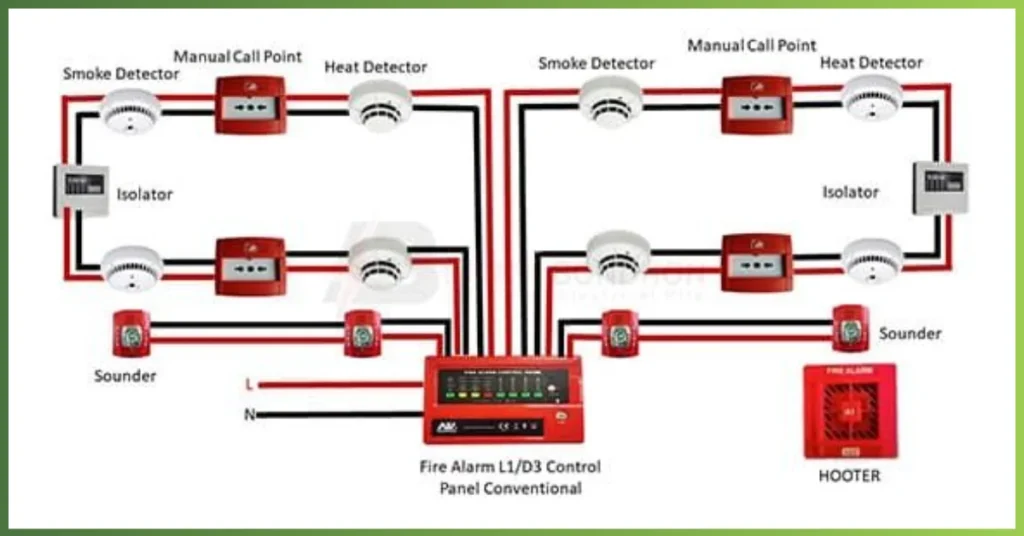
The control panel is the brain of the system, every detector loop, sounder circuit, and interconnect wire eventually terminates here. Getting the panel wiring right is just as important as wiring the detectors themselves.
- Input (detector) circuits: These bring signals from smoke detectors, heat detectors, and manual call points back to the panel. Each zone or loop should be labeled clearly at the panel terminals to avoid confusion during maintenance or fault-finding.
- Output (notification) circuits: These carry power to sounders, hooters, and strobes. Output wiring is usually a separate circuit from detector input wiring and should never share the same cable run.
- Power supply wiring: The panel needs a dedicated mains feed plus a battery backup connection, so the system keeps working during a power cut.
- Auxiliary/relay outputs: Many panels include relay terminals for interfacing with lifts, HVAC shutdown, or fire brigade notification systems — these need correct polarity and load ratings to function during an actual fire event.
For a full visual reference of how these circuits connect end-to-end — from detectors through to the panel and notification devices — see our complete fire alarm system schematic.
Panel wiring standards also vary depending on occupancy type. Commercial and public buildings often have stricter requirements around zoning and interconnection — our guide on whether smoke detectors are mandatory in commercial spaces breaks down what’s legally required versus recommended.
If your building already has an intrusion or access system installed, panel wiring should also be coordinated so the two systems don’t conflict — something we handle regularly on our security alarm system projects in Lahore.
Wireless Smoke Detectors: An Alternative to Hardwiring
Not every building can accommodate cable runs — older structures, rented spaces, or heritage buildings often can’t be rewired without major disruption. In these cases, RF-interconnected wireless smoke detectors are a practical alternative:
- Detectors communicate over a radio signal instead of a physical interconnect wire
- Still trigger simultaneously — when one unit senses smoke, all linked units sound
- Battery-powered, so no dependency on building electrical circuits
- Faster to install with no wall or ceiling cutting required
Wireless systems trade a slightly higher per-unit cost for significantly lower installation disruption — worth considering for retrofit and renovation projects.
Professional Installation Tip
If you’re setting up detectors in offices, schools, or factories, it’s best to hire certified technicians.
GreenTech Solutions provides complete fire alarm installation, maintenance, and testing across Pakistan. You can explore different types of detectors on our Smoke Detector page.
We specialize in:
- Fire alarm control panels
- Addressable and conventional smoke detectors
- Wiring and commissioning
- Esser and Tanda system integration
Pakistani Fire Safety Code Requirements for Wiring
Beyond international references like NFPA 72, smoke detector wiring in Pakistan should also account for local requirements:
- Rescue 1122 Fire Code compliance for commercial and public buildings, particularly around detector spacing and interconnection requirements
- Wiring work on commercial fire alarm systems should be carried out by PEC (Pakistan Engineering Council)-registered electrical contractors or supervised by a certified fire safety consultant
- Provincial building codes may require Class A wiring and dedicated fire-rated cabling for high-occupancy buildings (hospitals, schools, factories)
GreenTech Solutions designs and installs wiring systems that meet both international standards and local Rescue 1122 requirements, so your system passes inspection the first time.
Safety Precautions
- Always disconnect power before wiring.
- Use fire-rated cables for commercial buildings.
- Test the system every 6 months.
- Replace detectors every 8–10 years.
- Follow local fire and electrical codes.
What Does Professional Smoke Detector Wiring Cost?
Pricing depends on system type and building size, but generally falls into three tiers:
- Basic tier — 2-wire conventional systems for homes and small shops (few detectors, single zone)
- Standard tier — 3-wire interconnected systems for offices and mid-sized commercial spaces
- Advanced tier — Class A addressable loop systems for hospitals, factories, and high-rises, including control panel integration and Esser/Tanda device commissioning
Request a free site assessment and our team will recommend the right tier and provide a formal quote.
Frequently Asked Questions
Smoke detectors should be wired in a series or loop, depending on the system type. For home systems, connect power (+ and –) and an interconnect wire if you have more than one detector.
Not all. 2-wire smoke detectors are common for small setups. But 3-wire systems are used when you want multiple detectors to sound together.
A smoke detector senses small smoke particles using either:
- Ionization sensors – best for fast-flaming fires.
- Photoelectric sensors – best for slow, smoldering fires.
- When smoke enters, it disrupts the sensor’s operation, triggering an alarm signal. In wired systems, this signal passes to the next detector or the main fire alarm panel.
It can be both.
Hardwired smoke detectors usually use AC (120V or 220V) power with a DC battery backup.
Panel-connected detectors often use DC power (24V) supplied from the control panel.
For a single home smoke detector, DIY wiring is generally acceptable. For commercial buildings, Rescue 1122 and most provincial codes require installation by a certified electrical contractor or fire safety company to pass inspection and insurance requirements.
Costs vary by system type — a basic 2-wire home setup costs far less than a Class A addressable loop for a factory or hospital. GreenTech Solutions provides a free site assessment to give you an accurate quote based on your building.
Generally no — wired and wireless detectors use different communication methods and typically can’t be combined on the same loop or zone. Buildings needing both usually run them as separate, independently monitored systems.
Final Thoughts
A correctly wired smoke detector system gives peace of mind. It ensures instant fire detection and fast alerts, protecting lives and property.
If you’re upgrading your building’s fire safety system, connect with GreenTech Solutions, your trusted partner in fire detection technology across Pakistan.
Need help choosing the right system?
Greentech will help you choosing the suitable and appropriate detector for you.

