
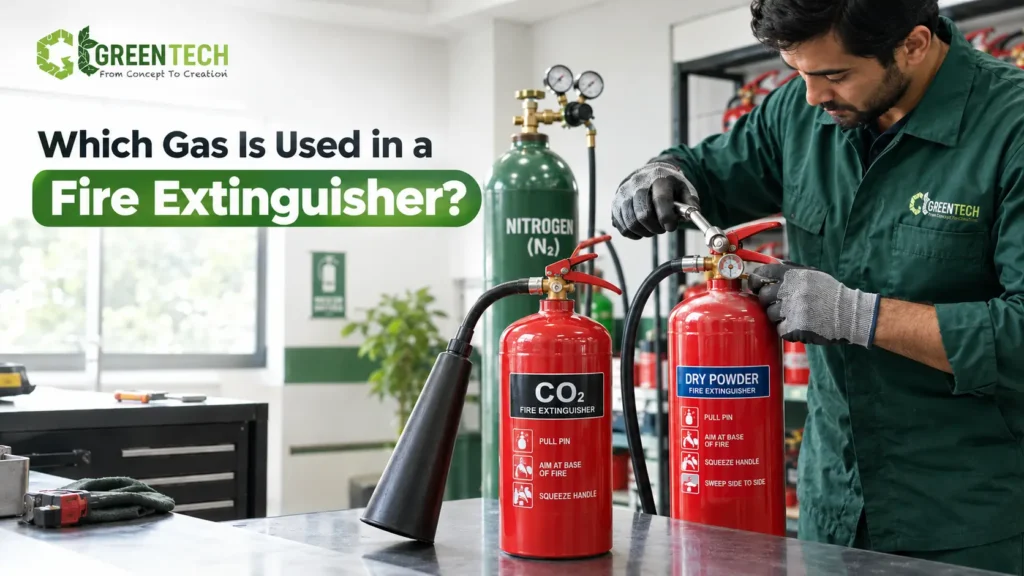
A fire extinguisher is a small, pressurised cylinder that can stop a fire in its first minute, before it spreads. Many people want to know what is inside it. The answer depends on the type of extinguisher and the type of fire it is built for.
So, which gas is used in a fire extinguisher? The most common is carbon dioxide (CO₂). Others include clean agent gases, such as FM-200 and Novec 1230, and inert gases, such as argon and nitrogen. Nitrogen is mostly used to push other agents out of the cylinder, not to put out the fire itself.
GreenTech Solution provides reliable fire safety equipment and solutions in Pakistan, helping businesses choose and maintain the right fire protection systems for their needs.
This guide covers each gas, how it works, which fires it suits, and where it fails. It also helps you choose the right extinguisher in Pakistan.
Don’t Wait for an Emergency—Strengthen Your Fire Safety Now!

Understanding Fire Extinguishers and How They Put Out Fire
Every fire needs three things: heat, fuel and oxygen. Remove one and the fire dies. Every extinguisher works by attacking at least one side of this triangle:
- Cooling removes heat (water, CO₂'s cold discharge)
- Smothering removes oxygen (foam, CO₂, inert gases)
- Interrupting the chemical reaction stops the fire from sustaining itself (dry powder, clean agents)
What Does a Fire Extinguisher Contain?
A fire extinguisher cylinder holds two things: an extinguishing agent and a propellant that pushes it out. The agent can be water, foam, dry powder, wet chemical or a gas. The propellant is often nitrogen or compressed air.
Some extinguishers use a gas as the agent itself. This is why people search for the "gas in fire extinguisher" or the "fire extinguisher gas".
Which Gas Is Used in Fire Extinguishers? Main Gases Explained
Three groups of gases are used in fire protection: carbon dioxide, clean agent gases, and inert gases.
1. Carbon Dioxide (CO₂)
How It Works
CO₂ is stored in the cylinder as a liquid under high pressure. When you squeeze the handle, it expands into gas and turns partly into extremely cold "dry ice" snow. This displaces the oxygen around the fire and cools the fuel at the same time.
Key Advantages
- Leaves no residue, so equipment is not damaged
- Does not conduct electricity
- Works quickly on small flammable liquid and electrical fires
Common Uses
Offices, server rooms, laboratories, switchboards, generators, and workshops. GreenTech Solution supplies CO₂ fire extinguishers in sizes such as 2 kg and 5 kg for different spaces.
2. Clean Agent Gases (FM-200, Novec 1230)
How They Work
Clean agents such as FM-200 (HFC-227ea) and Novec 1230 (FK-5-1-12) are stored as liquids and released as gas. They absorb heat and interrupt the chemical reaction of the fire, so they extinguish quickly at low concentrations without lowering oxygen to dangerous levels.
Key Advantages
- Leave no residue and are safe for sensitive electronics
- Fast-acting
- Safe for occupied spaces when designed correctly
Common Uses
Mostly in fixed systems for data centers, control rooms, and archives. See our FM-200 fire suppression system for a full-room solution. For portable use, Halotron extinguishers are a clean agent alternative.
Not Sure Which Fire Extinguisher Fits Your Site?
Our fire safety experts will match the right extinguisher type and gas to your building and its hazards.

3. Inert Gases (IG-55, IG-541, Argon, Nitrogen)
How They Work
Inert gas blends such as IG-55 (argon and nitrogen) and IG-541 (nitrogen, argon and a little CO2) are released into a room to lower oxygen to a level where fire cannot continue while still staying breathable for a short time.
Key Advantages
- Natural gases with no chemical breakdown products
- No residue and no damage to equipment
- Environmentally friendly
Common Uses
Server rooms, telecom facilities, museums, and critical infrastructure through engineered fire suppression systems, not hand-held extinguishers.
CO2 vs Nitrogen: Propellant vs Extinguishing Agent
Is Nitrogen Used to Fight Fires Directly?
Nitrogen is rarely the main extinguishing agent in a portable extinguisher. Its usual job is as a propellant. It sits in the cylinder under pressure and pushes the real agent, such as dry powder or foam, out through the hose. In fixed systems, nitrogen is used as part of inert gas blends.
Which Gas Is Used in a Dry Chemical (ABC) Extinguisher?
An ABC dry chemical extinguisher is filled with dry powder, usually monoammonium phosphate. The gas used in it, normally nitrogen, is only the propellant. If you are looking for DCP fire extinguishers, the powder does the fire-fighting work, not the gas.
Why Is CO2 Used in Fire Extinguishers Instead of Oxygen?
Oxygen feeds a fire, so it would make things worse. CO2 is used because it does the opposite.
Oxygen Displacement
CO2 is heavier than air. It settles over the fire and pushes oxygen away from the fuel.
Extreme Cooling
As CO2 expands on discharge, it becomes extremely cold, which helps pull heat out of the burning material.
Clean Discharge (No Residue)
Unlike powder or foam, CO2 disappears into the air. There is nothing to clean up and no damage to machines or documents.
Non-Conductive for Electrical Fires
CO2 does not carry electric current, so it is a safe choice for an electrical fire extinguisher around live equipment. This is why it is the standard answer for anyone asking about a fire extinguisher for electrical fire.
Which Extinguisher Gas Works on Which Type of Fire?
Fires are grouped into classes by the fuel that is burning. Our guide to fire extinguisher classes explains each class in detail. In short:
Class B (Flammable Liquids)
CO2 works well on petrol, diesel, oils and solvents, especially for small fires.
Class C (Gas Fires)
Class C covers flammable gases such as LPG and methane in most classification systems. Gas extinguishers can help, but the first step is always to cut off the gas supply. For more, read our guide to gas cylinder safety.
Electrical Fires
CO2 and clean agents are preferred because they do not conduct electricity and leave no residue on equipment.
Where Gas Extinguishers Don't Work (Class A and Class F)
On Class A fires (wood, paper, cloth), CO2 can put out the flames but the material may reignite because it keeps smouldering. Water, foam or powder is better. For Class F fires (cooking oil and fat), you need a wet chemical extinguisher.
Types of Fire Extinguishers and Their Uses
Gas is only one part of the picture. People often ask how many types of fire extinguisher there are, or what the 4 types of fire extinguishers are. The four main types are:
- Water: for Class A fires such as paper, wood and fabric. See water type fire extinguishers.
- Foam: for Class A and Class B fires. See foam fire extinguishers.
- Dry powder (DCP/ABC): for Class A, B and C fires and often electrical ones.
- CO2: for Class B and electrical fires.
A fifth type, wet chemical, is made for kitchen fires, and specialist powders cover metal fires (Class D).
Knowing the type of extinguisher and its use is just as important as knowing the gas. Using the wrong one can spread the fire or put you in danger.
Limitations of Gas-Based Fire Extinguishers
Not Suitable for Deep-Seated Fires
Gas disperses quickly. On fires that burn deep inside materials, like stored paper, cotton or wood piles, it may not cool the fuel enough to prevent reignition.
Safety Notes for Enclosed Spaces
CO2 reduces oxygen. In small, closed rooms, discharging a large CO2 extinguisher can be hazardous. Ventilate the area after use and never stay in a space filled with discharged gas. The cold horn can also cause frostbite, so hold only the handle.
Gas-Based Fire Suppression Systems
Beyond portable cylinders, buildings use fixed gas systems that protect a whole room automatically.
CO2 Flooding Systems
These release CO2 into a sealed area, such as a generator room, and are used only where people are not present or can leave before discharge.
Clean Agent Systems for Server Rooms and Data Centres
Clean agents like FM-200 and Novec 1230 protect high-value electronics without leaving residue. GreenTech's special hazard systems are designed for these environments.
Inert Gas Systems
Argon- and nitrogen-based systems are chosen where a natural, environmentally friendly agent is preferred.
Where Are Gas Fire Extinguishers Used?
1. Server Rooms and Data Centres
Clean, non-conductive agents protect servers and networking gear.
2. Laboratories
Labs have sensitive instruments and flammable chemicals, so CO2 is a common choice.
3. Machinery and Electrical Panels
Switchgear, control panels and motors are ideal for CO2 and clean agents. Vehicles also carry them, so see our guide on the fire extinguisher for car.
Choosing the Right Fire Extinguisher in Pakistan
If you are buying a fire extinguisher in Pakistan, match it to the hazard first, then the size.
How to Identify a CO2 Extinguisher
Look for a black colour band or label, a hard horn with no pressure gauge, and a heavy, thick-walled steel or aluminium cylinder. The label should also list the fire classes it is rated for.
Available Sizes
CO2 extinguishers range from small 2 kg units for offices to 30 kg wheeled units for industrial areas. Choose by the area covered and the equipment at risk.
How Often Should Extinguishers Be Inspected and Refilled?
Check extinguishers visually every month for damage, tamper seals and pressure. Have them professionally serviced at least once a year, and refill them right after any use, even partial. Cylinders also need pressure testing at set intervals under the applicable standard. Our guide to fire safety equipment maintenance covers the full routine.
Protect Your Building with the Right Fire Safety Solution
From CO2 extinguishers to FM-200 suppression systems, GreenTech Solution supplies and installs it all across Pakistan.

FAQs: Which Gas is Used in Fire Extinguisher
The most common gas is carbon dioxide (CO₂). Clean agents such as FM-200 and Novec 1230, and inert gases such as argon and nitrogen, are used mainly in suppression systems. Nitrogen also serves as a propellant in many extinguishers.
CO2 does not conduct electricity and leaves no residue, so it does not damage equipment. It also smothers the fire by displacing oxygen.
Yes, mainly as a propellant that pushes dry powder or foam out of the cylinder. It is also a component of inert gas suppression blends.
CO2 extinguishers smother and cool the fire, leave no residue and suit electrical and flammable liquid fires. Dry powder extinguishers interrupt the combustion reaction, handle more fire classes, but leave a messy powder that can damage equipment.
They do not have a fixed shelf life, but they need regular servicing and refilling. Extinguishers can lose pressure or become damaged over time, and cylinders need periodic testing.
Conclusion: Choosing the Right Fire Extinguishing Gas
Understanding which gas is used in fire extinguishers helps you choose the right fire protection equipment for different fire risks. CO₂ is commonly used for electrical and flammable liquid fires, while clean agents and inert gases are often used to protect sensitive equipment and server rooms. Nitrogen is generally used as a propellant rather than the primary extinguishing agent.
However, gas-based extinguishers are not suitable for every type of fire. Always match the extinguisher to the relevant fire class and have your equipment inspected, serviced, and refilled regularly.
Not sure which extinguisher or suppression system is right for your building? Get a quote for fire extinguishers and fire suppression systems from GreenTech Solution and let our team recommend a suitable solution for your site.
